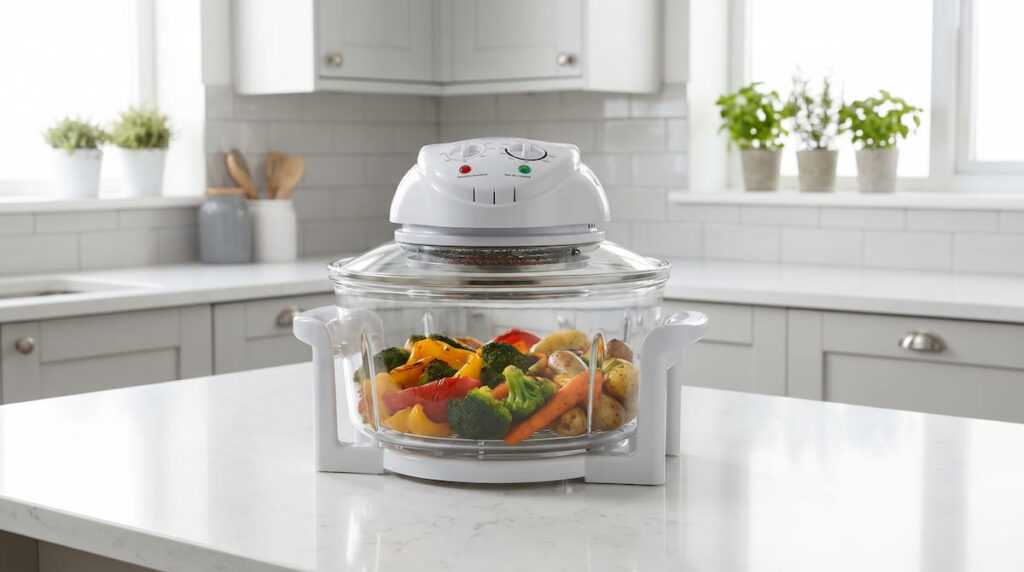
Are glass air fryers safer than nonstick? Yes — in every measurable way that matters for daily family cooking. Glass is chemically inert, contains no PTFE, no PFAS, and no coating of any kind to scratch, peel, or degrade over time. If you’ve been researching non-toxic cooking options, glass air fryers represent the most complete answer to the coating concern that most families are trying to solve.
I’m Wook, a bus driver and dad of two teenage boys. After spending months researching every non-toxic air fryer option available, glass kept coming up as the most thorough solution — not the most convenient, but the most chemically neutral. Here’s the honest picture of what glass air fryers actually offer and whether the tradeoffs make sense for your household.
Are Glass Air Fryers Safer Than Nonstick? The Chemistry Answer
Nonstick air fryer baskets are coated with PTFE — polytetrafluoroethylene — a fluoropolymer in the PFAS chemical family. When these coatings are scratched, worn, or overheated, they can release fluoropolymer particles and fumes into your kitchen air and food. This is the core safety concern that has driven families toward ceramic, stainless, and glass alternatives.
Glass cooking surfaces contain none of these compounds. Borosilicate glass — the type used in quality glass air fryers — is a silica and boron oxide compound that is completely stable at any temperature a home air fryer reaches. It does not react with food, does not release any compounds under heat, and does not degrade with repeated use.
According to the EPA’s PFAS resource page, the health concerns around nonstick coatings are specifically tied to fluoropolymer chemistry — a category that glass is entirely outside of. There is simply no chemical pathway for a glass cooking surface to produce the fume or flaking concerns associated with PTFE coatings.
For a full breakdown of what nonstick coatings actually release during cooking, see our guide on what chemicals air fryers release by material type.
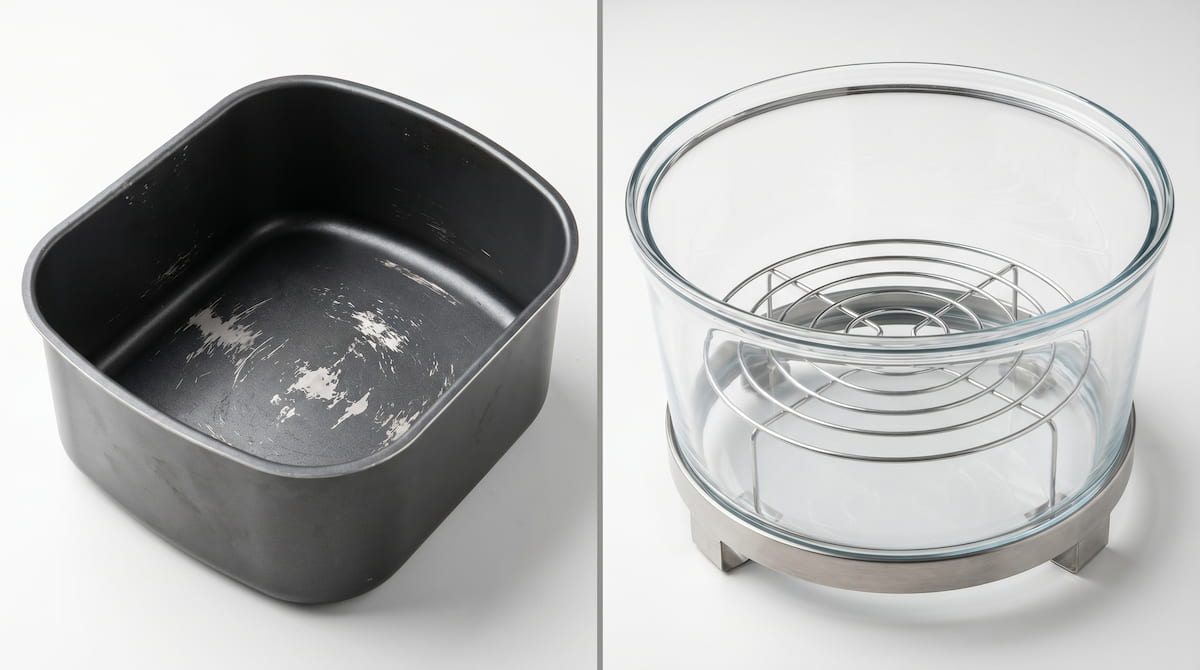
Glass vs Nonstick: Full Safety Comparison
| Safety Factor | Glass Air Fryer | Nonstick (PTFE) Air Fryer |
|---|---|---|
| PFAS chemicals present | ✅ None | ❌ Yes |
| Fume risk when heated | ✅ Zero — glass is inert | ⚠️ Medium-High when scratched |
| Coating flake risk | ✅ None — no coating exists | ⚠️ Fluoropolymer particles |
| Safe for birds and pets | ✅ Yes | ❌ No |
| Safety changes over time | ✅ Never — same profile always | ⚠️ Worsens as coating degrades |
| Chemical smell risk | ✅ Zero | ⚠️ Present with worn coating |
| Replacement needed | ✅ No coating to replace | ⚠️ Yes — coating degrades |
What Most People Get Wrong About Glass Air Fryers
The most common misconception is that glass air fryers are just a novelty — a transparent version of a regular air fryer with no real safety difference. That misses the point entirely. The safety difference isn’t about transparency; it’s about the complete absence of any coating chemistry at the cooking surface. There is literally nothing in a glass bowl to off-gas, scratch, or degrade in ways that affect what you’re eating or breathing.
The second misconception is that glass air fryers are fragile in everyday use. Borosilicate glass — the type used in the Big Boss and similar quality models — is the same material used in laboratory glassware and quality bakeware. It’s designed for repeated thermal cycling. Normal cooking and washing don’t crack it. The fragility concern is real only if you drop it on a hard floor — which applies equally to ceramic air fryer baskets.
The third misconception is that nonstick models are “safe enough” if you just avoid scratching them. The challenge is that coating degradation isn’t always visible. Micro-scratches from normal utensil use and repeated high-heat cooking cycles accelerate off-gassing before visible damage appears. Glass eliminates this variable entirely — there’s no threshold to worry about because there’s no coating at all. Our guide on air fryer VOC emissions by material explains exactly why this matters for indoor air quality.
How Glass Air Fryers Actually Work
Glass air fryers use a halogen or infrared heating element mounted above a glass cooking bowl. Hot air circulates around the food inside the glass chamber, cooking it through convection in exactly the same way a conventional basket air fryer does — just with a transparent glass bowl instead of a coated metal basket.
The stainless steel rack inside the glass bowl holds food off the bottom surface, allowing airflow underneath for even cooking. Because the bowl is glass, you can watch food cook in real time without opening the lid — a practical advantage most families appreciate once they’ve used it for a few weeks.
The Best Glass Air Fryer for Families: Big Boss 16Qt
The Big Boss 16Qt Glass Air Fryer is the most widely available and most popular glass option for families in the US market. Its 16-quart glass bowl handles whole chickens, large roasts, and family-sized batches of vegetables without batching — making it genuinely practical for households of four to six.
The cooking surface your food contacts is entirely glass and stainless steel — no coating chemistry of any kind at any layer. For families with pet birds, young children, or household members with chemical sensitivities, this is the most complete non-toxic upgrade available in the air fryer category.
Honest Tradeoffs of Glass Air Fryers
Fragility
Glass bowls can crack or shatter if dropped or exposed to sudden temperature changes. Most quality glass air fryer bowls are made from borosilicate glass, which is significantly more thermal-shock resistant than standard glass — but it’s still glass. Households with young children should factor this in.
Countertop Footprint
Glass air fryers are larger than basket models of equivalent capacity. The Big Boss 16Qt requires meaningful counter space and is not a compact solution for small kitchens.
Learning Curve
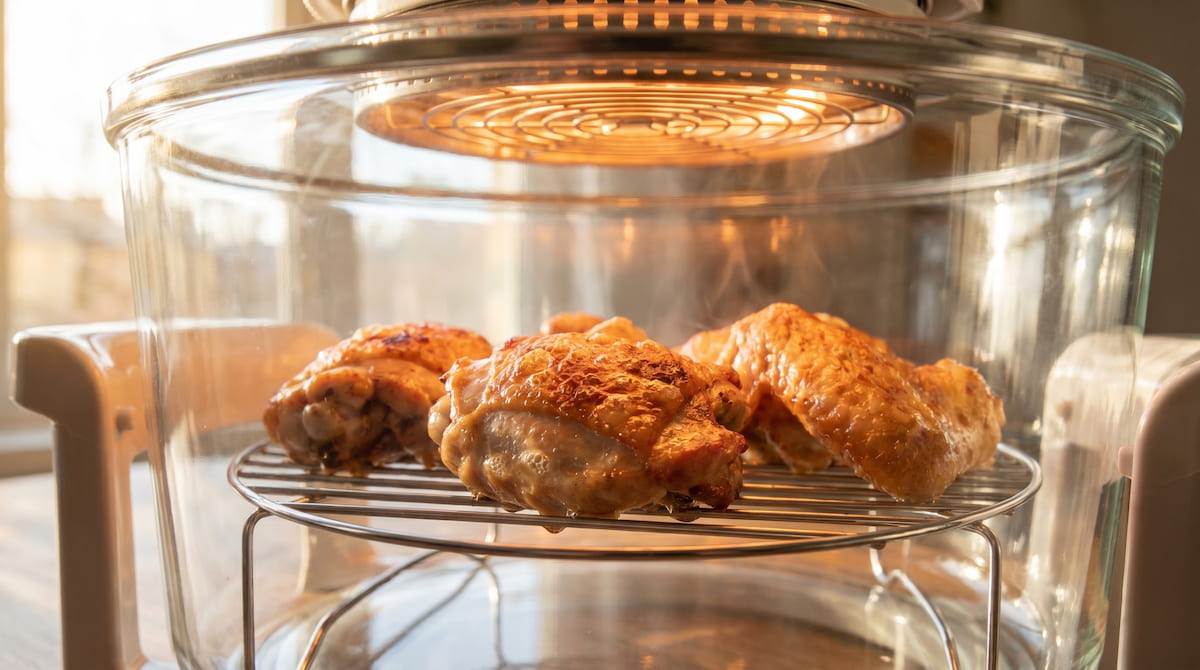
The halogen heating system cooks differently than basket air fryers — food browns from the top down more than from all sides. Most families find a two-week adjustment period before cooking results feel fully optimized.
Quick Safety Checklist for Glass Air Fryer Buyers
- ✅ Glass bowl confirmed as borosilicate — more thermal shock resistant than standard glass
- ✅ Rack and hardware confirmed as stainless steel — no coated metal parts contacting food
- ✅ Capacity appropriate for your household — 16Qt handles 4–6 people comfortably
- ✅ Counter space available — glass models have larger footprint than basket units
- ⚠️ Households with young children — handle glass bowl carefully, consider ceramic as alternative
- ❌ Very small kitchen with limited counter space — basket ceramic model is more practical
Is Glass Worth It Over Ceramic for Most Families?
For households with pet birds, young children, or chemical sensitivities — yes, unequivocally. For the average family cooking daily who simply wants to move away from PTFE, a certified PTFE-free ceramic model like the Ninja AF150AMZ delivers equivalent safety for practical purposes at a lower price point and smaller footprint.
Glass is the most complete solution. Ceramic is the most practical solution. Both are dramatically safer than any PTFE-coated basket for daily family cooking. For a direct comparison of both options, see our Ninja ceramic basket safety guide.
See Ninja AF150AMZ on Amazon →Frequently Asked Questions
Are glass air fryers actually safer than nonstick?
Yes — meaningfully so. Glass is chemically inert and contains no PTFE or PFAS compounds at any layer. Nonstick coatings carry fluoropolymer chemistry that can off-gas when overheated or degraded. For families concerned about coating safety, glass eliminates the variable entirely rather than managing it.
Do glass air fryers cook as well as nonstick?
Yes — with a short adjustment period. The halogen heating system produces excellent browning and crisping results, particularly for larger cuts of meat and whole vegetables. Foods that benefit from all-sides crisping may need occasional rotation compared to basket models.
Are glass air fryers harder to clean than nonstick?
The glass bowl is actually easier to clean than most people expect — food residue releases with warm soapy water and a soft sponge, and most glass bowls are dishwasher safe. The lack of a nonstick coating means you can scrub firmly without any damage concern.
Can glass air fryer bowls break during cooking?
Borosilicate glass bowls are designed for thermal cycling and are significantly more durable than standard glass. Normal cooking temperatures and thermal changes during regular air fryer use do not crack quality borosilicate bowls. The primary breakage risk is dropping the bowl on a hard surface.
Is glass air frying safe for birds?
Yes — glass produces no PTFE fumes under any cooking condition. For households with pet birds, glass and stainless steel air fryers are the only completely safe options. PTFE fumes from nonstick coatings are acutely toxic to birds even at normal cooking temperatures. Our guide on air fryer safety for pets and birds covers this in full detail.
What is the biggest glass air fryer available for families?
The Big Boss 16Qt is the most popular large-capacity glass air fryer in the US market. Its 16-quart capacity handles whole chickens and large family meals comfortably, making it the most practical glass option for households of four to six.
Is a glass air fryer better than ceramic for someone with asthma?
Both are significantly better than PTFE-based nonstick for asthma sufferers. Glass is technically the most inert option — zero coating off-gassing at any temperature. For most asthma households, a verified ceramic model like the Ninja AF150AMZ is sufficient and more practical. Our guide on the best air fryer for asthma sufferers compares both options in detail.
The Bottom Line: Are Glass Air Fryers Safer?
Yes — glass air fryers are the safest cooking surface option in the air fryer category. No coating, no PTFE, no PFAS, no degradation over time. The Big Boss 16Qt is the most practical glass option for US families, and it delivers on the safety promise completely.
For a full comparison of every non-toxic option across glass, stainless, and ceramic formats, our PFAS-Free Air Fryer Guide covers the complete 2026 landscape.