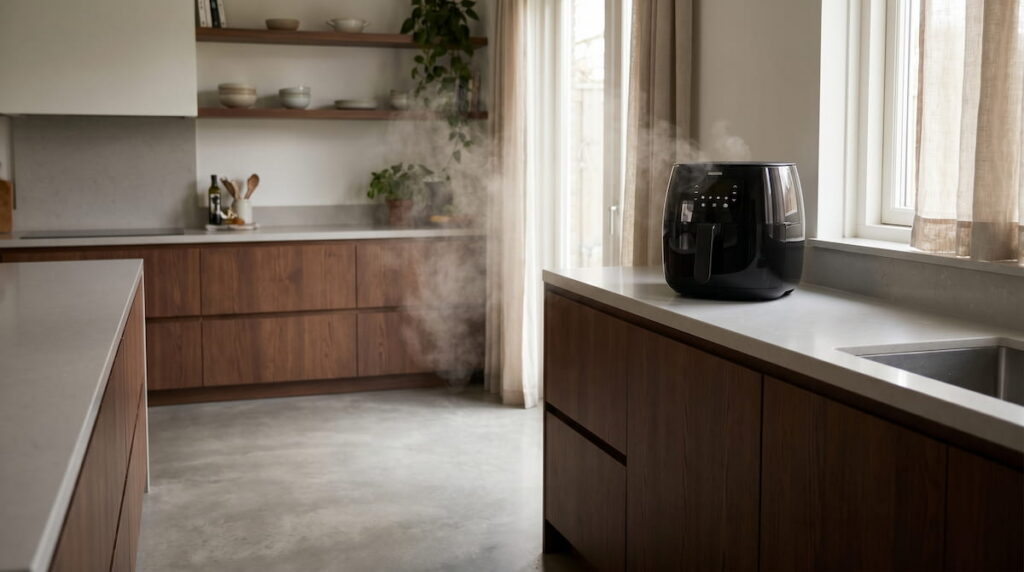
Can air fryers cause indoor air pollution? Yes — under certain conditions they can contribute to measurable air quality changes inside your kitchen, and the main factors are coating type, cooking temperature, and ventilation. Most families cooking daily have no idea this is happening because the effects are invisible.
I’m Wook, a bus driver and dad of two teenage boys. After our CO detector started triggering during air fryer use, I bought an indoor air quality monitor to find out what was actually in our kitchen air. What I found changed how our family cooks every day.
Can Air Fryers Cause Indoor Air Pollution? What the Tests Show
Research into cooking-related indoor air pollution consistently shows that high-heat cooking methods — including air frying — can temporarily elevate fine particulate matter (PM2.5) levels in kitchen air. A study published through the National Institutes of Health found that cooking with nonstick cookware at high temperatures produced measurable ultrafine particle counts above baseline indoor air quality levels.
The key variables that determine how much your air fryer affects indoor air quality are:
- Basket coating type — PTFE coatings release more airborne compounds than ceramic or stainless steel
- Cooking temperature — higher temps produce more particulates regardless of coating
- Food fat content — fatty foods generate more grease smoke than vegetables or lean proteins
- Kitchen ventilation — the single most impactful variable for actual air quality outcomes
- Basket condition — scratched or peeling coatings release significantly more compounds than intact surfaces
According to the EPA’s Indoor Air Quality resource, indoor air can be two to five times more polluted than outdoor air — and cooking is one of the primary contributors in residential settings.
What Specifically Do Air Fryers Release Into Kitchen Air?
| Compound | Source | Concern Level |
|---|---|---|
| Fine particulate matter (PM2.5) | Grease smoke, food combustion | ⚠️ Medium — ventilate kitchen |
| Volatile organic compounds (VOCs) | Heated cooking oils, food breakdown | ⚠️ Medium — open window |
| Fluoropolymer fumes (PTFE) | Degrading or overheated PTFE coating | ⚠️ Medium-High — switch coating |
| Acrolein | Overheated fats and oils | ⚠️ Medium — avoid oil overheating |
| Steam and water vapor | Moisture in food during cooking | ✅ None — completely harmless |
Is Air Frying Better or Worse Than Other Cooking Methods?
Compared to deep frying, air frying produces significantly less grease smoke and fewer airborne particulates — primarily because there’s no large volume of heated oil involved. Compared to oven roasting at equivalent temperatures, air frying produces similar particulate levels with the added variable of coating fumes if a PTFE basket is involved.
The honest answer is that air frying is one of the cleaner cooking methods available when using a PFAS-free basket and basic ventilation. The indoor air quality concern is real but manageable — it’s not a reason to stop air frying, it’s a reason to make two specific changes: switch to a non-toxic basket and open a window.
What Our Family Changed After Testing Our Air Quality
When I put an air quality monitor next to our old PTFE-coated air fryer, PM2.5 levels spiked noticeably during cooking — especially when cooking fatty foods like bacon or chicken wings. After switching to the Ninja AF150AMZ with its PTFE-free ceramic basket, the same monitor showed significantly lower readings during identical cooking sessions.
The difference wasn’t subtle. The ceramic basket eliminated the fluoropolymer fume component entirely, leaving only normal cooking vapor and light grease smoke — both of which a cracked window handles easily.
If you’re curious about what the ceramic basket is actually made of and how it compares to PTFE, our guide on the Ninja ceramic basket covers the full material breakdown.
Quick Safety Checklist for Better Indoor Air Quality
- ✅ Open a window or run the range hood during every cook session
- ✅ Use a PTFE-free ceramic or stainless steel basket
- ✅ Keep basket clean — grease residue amplifies smoke during cooking
- ✅ Avoid cooking oils with low smoke points at high air fryer temperatures
- ✅ Inspect basket monthly for scratches or peeling
- ⚠️ Cooking fatty foods at 400°F+ — increase ventilation during these sessions
- ⚠️ Recurring chemical smell during cooking — inspect basket and consider replacing
- ❌ Closed kitchen with no ventilation and a scratched PTFE basket — highest risk combination
The Two Changes That Made the Biggest Difference for Our Family
After months of testing and research, our family settled on two non-negotiable habits:
1. PFAS-Free Basket Only
Switching from a PTFE-coated basket to the Ninja AF150AMZ ceramic basket eliminated the fluoropolymer fume variable entirely. For families cooking daily, this is the highest-impact single change for long-term indoor air quality.
2. Window Open Every Single Cook
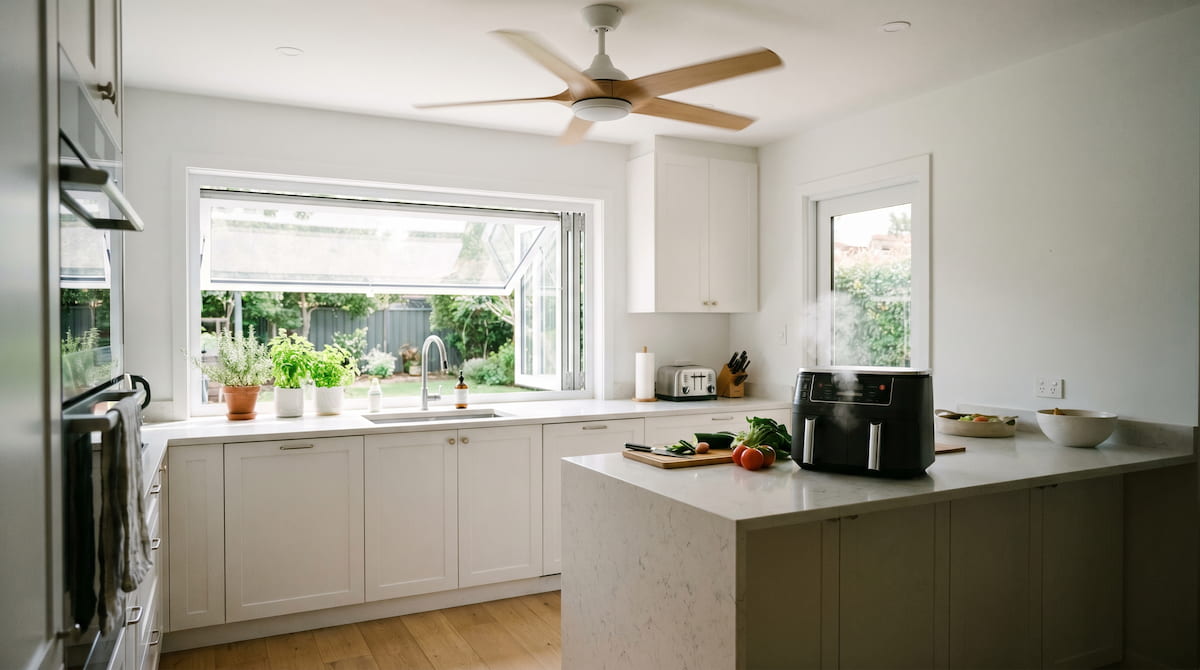
Even a two-inch gap in a nearby window drops particulate buildup dramatically in a standard kitchen. On days where opening a window isn’t practical, we run our range hood on low for the entire cooking session. Either habit alone makes a meaningful difference — both together keeps our air quality readings consistently clean.
For families who want to understand the full range of what air fryers release and how different models compare on indoor air quality, our PFAS-Free Air Fryer Guide covers every major material type with safety context.
See Today’s Price on Amazon →Frequently Asked Questions
Do air fryers pollute indoor air?
They can temporarily elevate fine particulate matter and VOC levels during cooking, particularly with PTFE-coated baskets and fatty foods at high heat. Basic ventilation and a PFAS-free basket bring indoor air quality impact to minimal levels comparable to other standard cooking methods.
Is air frying healthier than other cooking methods for indoor air quality?
Generally yes — air frying produces less smoke and fewer airborne particulates than deep frying or high-heat stovetop cooking. Compared to oven roasting, it’s roughly equivalent with the added coating fume variable if using a PTFE basket.
How do I know if my air fryer is affecting my air quality?
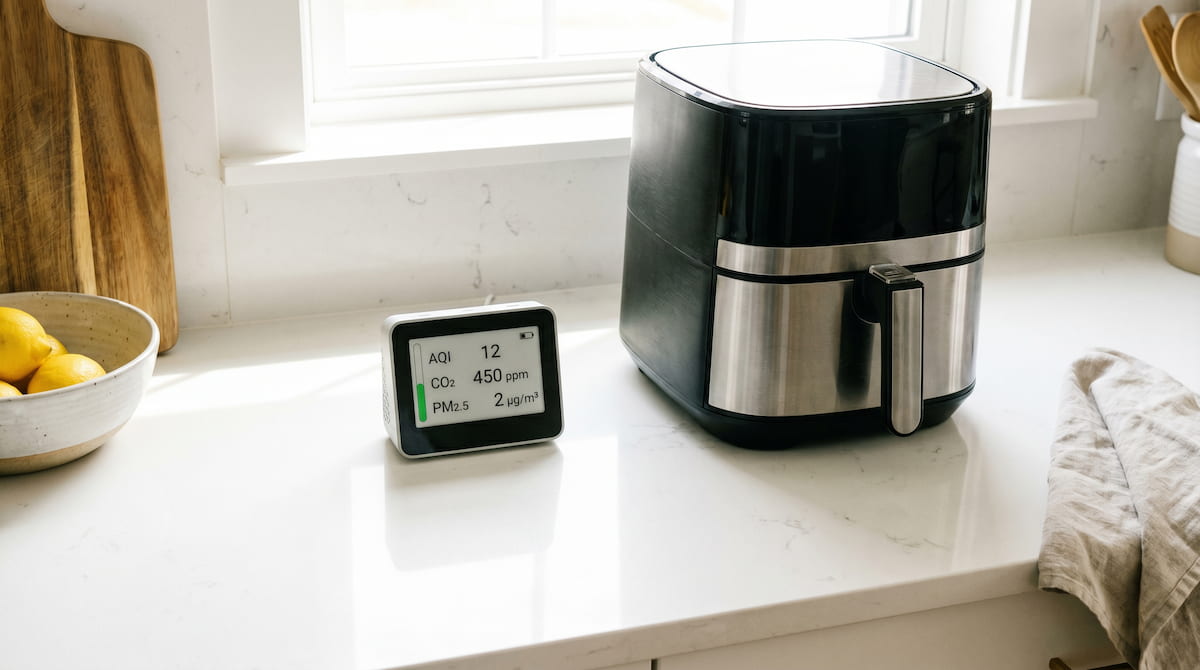
An indoor air quality monitor placed near the unit during cooking gives real-time PM2.5 readings. A noticeable chemical smell, recurring headaches after cooking sessions, or a CO detector triggering are all practical warning signs without needing a monitor.
Does a ceramic air fryer produce less indoor air pollution?
Yes — significantly less than a PTFE-coated basket under equivalent cooking conditions. Ceramic is chemically inert and doesn’t release fluoropolymer fumes when heated. The remaining air quality impact from a ceramic basket is primarily normal cooking vapor and light grease smoke.
Is it safe to use an air fryer every day indoors?
Yes, with two conditions: use a PFAS-free ceramic or stainless basket, and maintain basic kitchen ventilation during cooking. Daily use with these two habits in place presents no meaningful indoor air quality concern beyond normal cooking.
Next in this cluster: do air fryers release toxic fumes more broadly — and what does the research actually say about the specific compounds involved? We cover the complete picture in our guide on whether air fryers release toxic fumes.