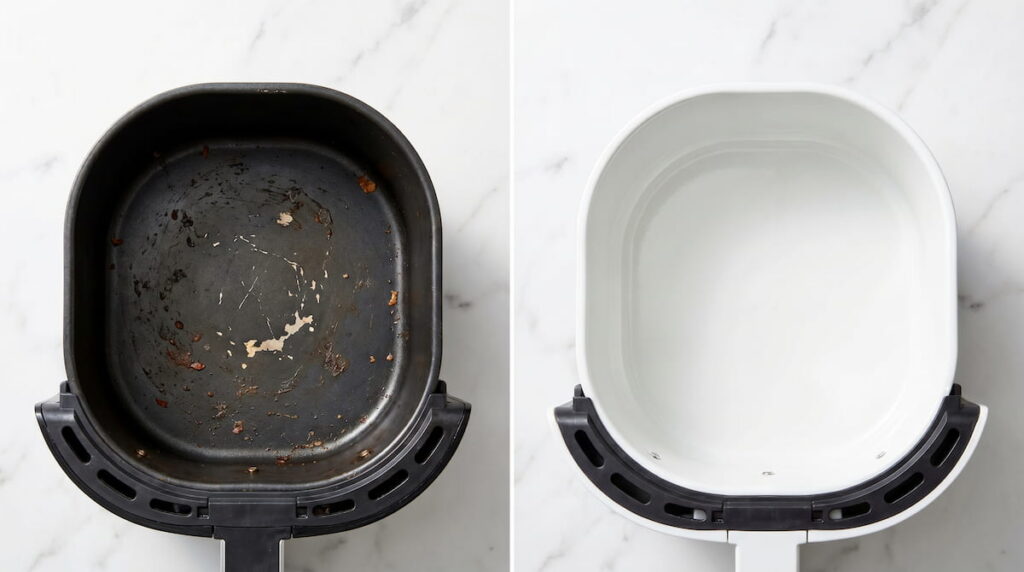
Is ceramic better than Teflon for air fryers? On safety, yes — clearly and meaningfully. On everyday cooking performance, it depends on how you define better. This guide gives you the honest side-by-side so you can make the right call for your family without relying on marketing claims from either side.
I’m Wook, a bus driver and dad of two teenage boys. We used a Teflon-coated air fryer for about eight months before switching to ceramic — and I tracked the differences carefully because I wanted to know whether the safety upgrade came with any real cooking tradeoffs. Here’s exactly what I found.
Is Ceramic Better Than Teflon for Air Fryers? The Core Difference
The fundamental difference between ceramic and Teflon coatings comes down to chemistry. Teflon is a brand name for PTFE — polytetrafluoroethylene — a fluoropolymer in the PFAS chemical family. Ceramic coatings are sol-gel silica-based surfaces that contain no fluoropolymers of any kind.
That chemistry difference has real-world consequences for families cooking daily at high heat:
| Factor | Ceramic | Teflon (PTFE) |
|---|---|---|
| PFAS chemicals | ✅ None | ❌ Present |
| Fume risk at high heat | ✅ Minimal | ⚠️ Medium-High above 500°F |
| Flake chemical risk | ✅ Inert silica | ⚠️ Fluoropolymer particles |
| Safe for birds and pets | ✅ Yes | ❌ No |
| Initial nonstick performance | 🟡 Good | ✅ Excellent |
| Nonstick longevity | 🟡 Moderate | 🟡 Moderate |
| Scratch resistance | 🟡 Moderate | 🟡 Moderate |
| Ease of cleaning | ✅ Easy | ✅ Easy |
Where Teflon Has the Edge
Being honest about this matters — Teflon coatings do have one genuine performance advantage: initial nonstick release. Fresh Teflon surfaces are exceptionally slippery, which makes delicate foods like fish, eggs, and breaded items release more easily than they do from a ceramic surface.
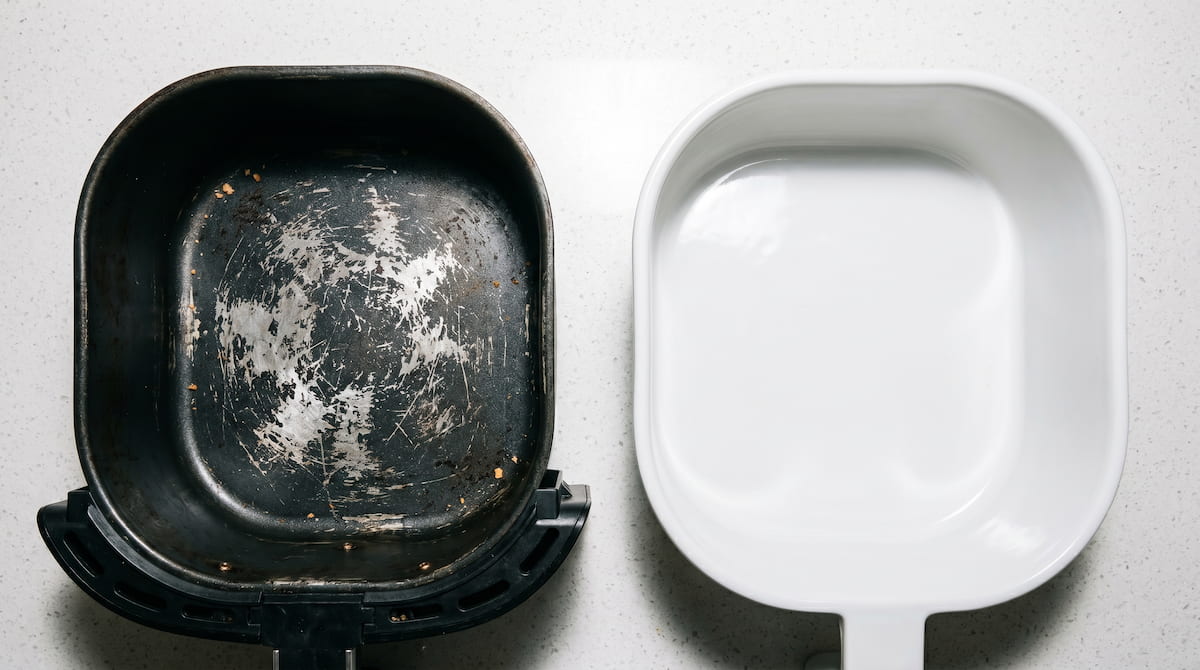
For the first six to twelve months of careful use, a Teflon-coated basket is marginally more convenient to cook with. The problem is that this performance advantage erodes quickly — and as it erodes, the safety concerns increase simultaneously. A worn Teflon basket is both less nonstick and more chemically concerning than when it was new.
Ceramic coatings lose their nonstick performance as they wear, but the safety profile doesn’t worsen at the same rate. A worn ceramic basket is less convenient — it sticks more — but it doesn’t produce the same fume and flaking concerns as a worn Teflon basket.
The PFAS Factor — Why It Changes the Calculation
The health concerns around Teflon coatings are specifically tied to PFAS chemistry — a class of synthetic fluoropolymer compounds that have been linked to a range of health concerns with long-term exposure. According to the EPA’s PFAS resource page, these chemicals are persistent in both the environment and the human body, which is why regulatory attention around them has increased significantly in recent years.
Ceramic coatings contain no PFAS. This isn’t a minor distinction — it’s a fundamental chemistry difference that removes an entire category of long-term exposure concern from daily family cooking.
What Our Family Noticed After Switching
When we switched from our Teflon-coated basket to the Ninja AF150AMZ ceramic basket, here’s what we actually experienced day-to-day:
- Chemical smell — gone immediately and permanently
- CO detector alarms — stopped completely
- Food sticking — slightly more than the old Teflon basket for the first few weeks, then comparable with parchment liners for sticky foods
- Cleaning — essentially identical to Teflon with soft sponge and dish soap
- Peace of mind — significantly better, especially cooking for our teenage boys every night
The cooking tradeoff was real but minor and easily managed. The safety improvement was immediate and significant. For our family, that’s not a close call.
Who Should Switch From Teflon to Ceramic
- ✅ Families with young children cooking daily — long-term exposure reduction matters most here
- ✅ Households with pet birds — PTFE fumes are acutely dangerous to birds even at normal cooking temps
- ✅ Anyone whose current Teflon basket is scratched, worn, or over a year old
- ✅ Anyone who has noticed a chemical smell during cooking
- ✅ Families cooking at high temperatures regularly (400°F+)
Who Can Continue With Teflon (With Caution)
- 🟡 Adults-only households with excellent kitchen ventilation
- 🟡 Occasional users (once or twice per week) with an intact, unworn basket
- 🟡 Anyone who replaces their basket annually and never uses metal utensils
Quick Safety Checklist Before Deciding
- ✅ Current basket shows no scratching or peeling — still in the safer Teflon zone
- ✅ Cooking below 400°F consistently — below the fume acceleration threshold
- ⚠️ Basket over 12 months old with daily use — worth inspecting carefully before continuing
- ⚠️ Any chemical smell during cooking — switch immediately regardless of visible damage
- ❌ Scratched or peeling Teflon basket — replace now, do not continue using
- ❌ Birds or pets in the kitchen during cooking — switch to ceramic or stainless immediately
For families who want to go further than ceramic and eliminate coating concerns entirely, our guide on PFAS-free air fryers covers stainless steel and glass options alongside the top ceramic models for 2026. And if you’re specifically evaluating the Ninja ceramic basket, our dedicated Ninja ceramic basket guide covers the full material certification and real-world performance in detail.
Frequently Asked Questions
Is ceramic coating safer than Teflon?
Yes — meaningfully so. Ceramic coatings contain no PTFE, no PFOA, and no PFAS of any kind. The fume and flaking concerns specifically associated with Teflon coatings do not apply to certified ceramic surfaces.
Does ceramic nonstick last as long as Teflon?
Both coating types show similar wear timelines with daily use — typically 1.5 to 3 years before significant nonstick performance loss. The key difference is that ceramic wear is a convenience issue, while Teflon wear is a safety issue.
Is Teflon still used in air fryers in 2026?
Yes — many budget and mid-range air fryers still use PTFE-based nonstick coatings. Always check the product listing for explicit PTFE-free and PFAS-free certification rather than assuming based on price point or brand name.
Can I season a ceramic basket like cast iron?
A light application of high-smoke-point oil before first use helps ceramic surfaces perform better initially, but ceramic doesn’t build up seasoning layers the way cast iron does. The coating’s nonstick properties come from the silica surface itself, not accumulated oil layers.
Is the Ninja AF150AMZ ceramic basket actually Teflon-free?
Yes — Ninja explicitly certifies the AF150AMZ basket as PTFE-free and PFAS-free. This is a specific chemical certification, not just a marketing label. Our full breakdown of the Ninja ceramic basket covers how to verify this certification and what it means in practice.
Next in this cluster: stainless steel is often marketed as the ultimate non-toxic air fryer option — but is it actually as safe as it sounds, and what does “stainless steel interior” really mean in practice? We cover the full picture in our guide on whether stainless steel air fryers are really non-toxic.